Chapter 5
Just after six, Mom and Dad come home.
“Well,” Mom sighs, tired but satisfied, “you can really tell there was a lot of publicity for Gouda by Candlelight. It’s been busy all day.”
When Pierre comes into the room, they sit down at the table to eat.
“I’m going to play a Pavarotti piece on my own during the Christmas concert,” Liza says after they say grace. She looks around expectantly.
Mom pauses, the vegetable spoon hovering over the bowl of Belgian endive. Dad gives Liza an approving look and nods.
“Are you brave enough for that?” Pierre asks teasingly.
“I think so,” Liza shoots back.
“That’s lovely,” Mom says. “I’m already curious to hear how it will sound. I spoke to Aunt Liesbeth on the phone today, and she and her family are arriving here in Gouda on the Friday of the performance. It’s going to be very busy in the church that evening. And,” Mom adds, “they’re planning to stay until New Year’s Day before heading back to Switzerland.”
“Wow,” Liza says. “I’m already looking forward to the holidays.”
For the rest of the meal, they talk about performances, holiday memories, and how the rooms will be divided while the family is staying over.
Since Liza cooked dinner, Pierre has to clear the table and do the dishes. Liza quickly disappears behind her books. She does a few English assignments, rereads a chapter of history, and then picks up her violin again. Before she knows it, it’s almost eight o’clock—time to go to Mr. Noot’s.
She bundles herself up, pulls on her boots and gloves, and steps out the front door. She hesitates for a moment about which way to go, then decides to walk through the Willem Vroesen Garden. The path through the garden is lit by the enormous church windows.
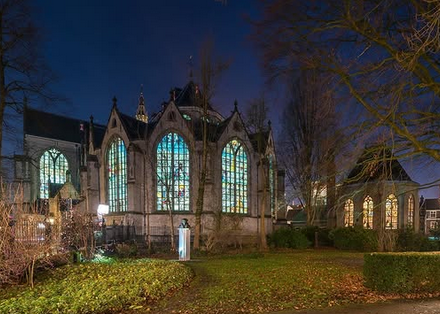
The talking beech tree is telling its final story of the evening. A few people are still standing there, listening. If Uncle Sander is there, she’ll bring him along sometime to hear all the stories.
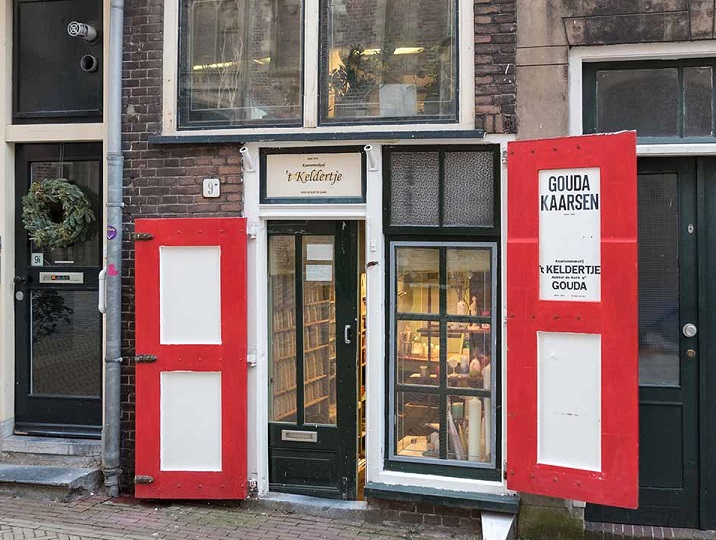
Her parents don’t approve of her walking through the garden alone after dark, so she doesn’t tell them that she does this regularly. She isn’t afraid, but she stays alert when she’s here by herself. She crosses the little bridge at the back of the garden, walks past the rear of the shops along the Tiendeweg, continues almost as far as the candle shop, and then turns right toward the Market.
Mr. Noot lives above the café In de Wijze Kan. If you want to visit him, you have to take the stairs at the back of the café. Liza pushes open the café door and steps inside. A smoky haze greets her, along with the smell of alcohol and stale air. Along the bar on the left, a few scruffy men sit with glasses of beer in front of them. One of them looks up when Liza enters.
“Good evening, missy. Care for a drink too?”
“Good evening,” Liza replies politely, then says to the bartender, “I’m here to see Mr. Noot.”
“All right. Do you know the way?”
Liza shakes her head.
“Just head up the stairs—you’ll find it.”
“Give him my regards,” slurs the man at the bar. “He makes such beautiful music, doesn’t he?”
“Yes, that’s true,” Liza says. The man turns back to his glass and has already forgotten her.
Good thing Mr. Noot looks at things so sensibly, Liza thinks. Otherwise, you might be afraid to walk through here every day.
At the back of the café, in the narrow hallway near the washrooms, is the staircase leading upstairs. At the top is a tiny landing with a coat rack and two doors side by side. On one of them, a crumpled note is taped up: Please knock.
Like a well-behaved girl, Liza taps lightly on the door. It swings open, and Mr. Noot welcomes her inside with a broad gesture.
“Glad you’re here. I found the sheet music,” he says right away. He walks over to the coffee table and picks up a stack of papers. “Here, have a look. I’ll pour the coffee.”
Liza takes the music and sinks into a deep armchair. She looks around the room. What an eclectic assortment Mr. Noot has put together. Not a single piece of furniture matches another. Everywhere, there are piles of books and sheet music. Instruments are scattered throughout the room. The piano stands out most, but she also spots a guitar and a violin. On the dining table by the window overlooking the market lies a flute.
Liza gets up and walks over to the window. Mr. Noot returns with two mugs of coffee and sets them on the table.
“So, you can admire the Christmas tree from a different angle,” he says with a smile.
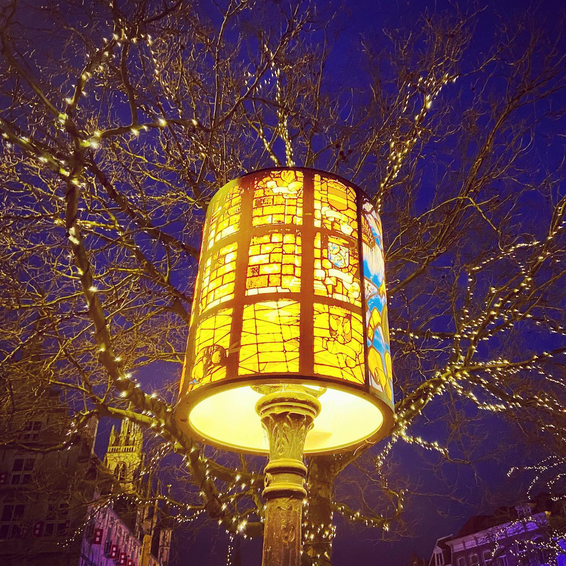
“You live in a lovely place,” Liza says sincerely. “And now that you see those lampshades everywhere with the stained-glass windows of the Sint-Jan, the whole city centre feels like home to me.”
“Yes, it’s cosy now,” he says, “but during King’s Night, the Jazz Festival, and the fair, I’d rather be hiding in a cabin in the woods. They could cancel all that, as far as I’m concerned. But it is what it is.” He shrugs. “Come, sit down. We can chat and watch outside while we drink our coffee.”
Liza sits down and places the sheet music in front of her.
“It looks a bit complicated here and there,” Mr. Noot says, pointing at the pages, “but if you practise as much as possible until the performance, you should manage quite well.”
Liza looks at him. “But the music is already in my head,” she says softly.
“Of course,” Mr. Noot says with a smile. “I’ve heard you play. I don’t doubt for a moment that you’ll pull this off.”
She smiles at him gratefully and stirs her coffee. She drinks it in small sips, then stands when her mug is empty.
“I’ll practise as soon as I get home,” she says.
“If you get stuck, just come by again. I’ll walk you downstairs—you never know if someone’s had one drink too many,” he adds with a wink.
Liza grips the handrail tightly. The steps are so narrow that she’s afraid her feet might slip. Down in the café, little has changed. The same men are still at the bar, now bent even further over their glasses, as if too tired to hold their heads up. The bartender is pouring another beer for one of his guests.
“Goodbye,” he says to Liza and Mr. Noot. Liza smiles back. She wonders how such a polite, friendly man can run a café. People come here to drink alcohol, something Liza doesn’t find very admirable. Or is he different from how he appears? The thought flits through her mind, and just as quickly, she scolds herself. Stop judging.
Mr. Noot holds the door open for her. Outside, it’s still bitterly cold.
“Not pleasant to be out now,” he says.
“No,” Liza replies thoughtfully, “especially if you have to sleep on the street.”
Mr. Noot looks at her in surprise. “You care about people who are homeless?”
“Yes,” Liza says. “I know someone who is. He sleeps in the Willem Vroesen Garden.”
Mr. Noot falls silent for a moment. “Maybe you should ask the shelter what you can do for him.”
“He slept in our shed last night, but my parents can’t know.” She hesitates, then adds, “I gave him the money I earned on Gouda by Candle Night, but my father didn’t think it was a good idea. He calls homeless people good-for-nothings.”
“It’s true they often don’t work much,” Mr. Noot says carefully, “but there’s usually a very understandable reason—mental health issues, or being abandoned by others.”
Mr. Noot wraps his arms around himself to keep warm. “Brr. I don’t know what I can do for you or for him right now, but if you have questions or need help, I’m always here.”
Liza sighs with relief. “Thank you. It’s good to know not everyone speaks badly about people who are homeless. I felt awful at home.”
“Good,” Mr. Noot says decisively. “We agree—you come to me if you don’t know what to do anymore.”
She nods. “See you tomorrow,” she calls over her shoulder as she walks away. Mr. Noot opens the café door and, with a broad sweep of his arm in farewell, slips back into the warmth of the pub.
Before turning into the church alley, she looks back at the Christmas tree towering above the market houses, as tall as the old Gothic town hall. There are hardly any people around now. Only a lone figure stands with his back to the tree, leaning against the barriers. He wears baggy clothes and a Santa hat.
Then he starts to cough. His body nearly folds in on itself, as if the effort gives the cough more force. Without thinking, Liza crosses the street to help him. The coughing fit eases, and the homeless man straightens up. He looks at her with strangely gleaming eyes.
“Who was that man you were with in the café?” he asks suddenly.
“What do you mean?” Liza asks, confused.
“Just what I said—the man you were with in the café,” the homeless man repeats.
“Oh,” she breathes, relieved. “He’s just my music teacher from school. He lives above the café. I picked up some sheet music for the Christmas concert. I’m playing a solo. Will you come?” she blurts out. “If you’re not sick, that is.”
The man grins. “If I’m sick, it’ll be nice to sit in a warm church. Of course I’ll come.” His intense gaze makes her blush.
“I should get home,” she says, then asks, “Where are you sleeping tonight?”
“I can go to the Salvation Army tonight—I managed to arrange that today.”
“Why do you live on the street?” she dares to ask.
“That’s a long story,” he deflects.
“Tell me,” she insists.
He chuckles softly. “I’ll keep it short. My parents thought I was a burden. That’s all. And my friends live on the street too.” He shrugs. “What’s your name?”
“Liza. And yours?”
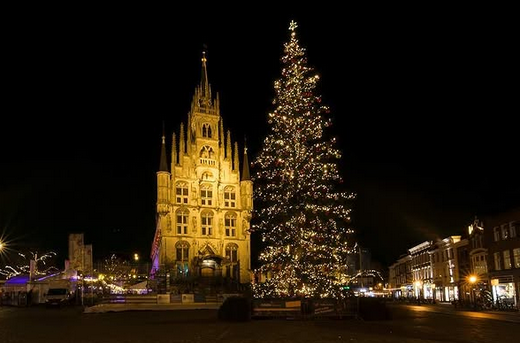
“Antonio.” He looks at the Christmas tree. “Funny, isn’t it? There’s money to decorate a tree, but none to help people like me.”
Liza is at a loss for words. She feels ashamed of the city authorities and the organizations meant to help. “I’d like to help you,” she says softly, “but I don’t know how.”
“It’s kind of you even to say that.”
He pulls off his glove and rubs his cheek. His hand trembles. He must be very sick—or freezing.
“Why don’t you go to the Salvation Army now?” Liza asks.
“Why sit in a smoky room full of dirty men and women when I can talk by candlelight with a beautiful young lady?” he says with a mischievous smile.
Liza smiles too, but then she notices a boy on a bicycle coming from the street beside the Sint-Jan. It’s Pierre. His eyes widen when he sees her standing so close to Antonio.
“Are you crazy?” he shouts. “Dad’s coming too. Get out of here!”
Liza starts walking immediately. Within seconds, she’s on the other side of the Christmas tree. Just then, her father cycles out of the alley. Antonio stays where he is. Dad looks at him suspiciously. What’s a homeless man doing by the tree? Liza can almost hear him think. Stealing ornaments? Cutting wires like last year?
He rides on, glancing back once more. Because Antonio is watching him, he doesn’t see Liza hiding behind the tree.
“I’m sorry,” she says afterward. “I don’t understand why people are so hard on each other.”
Antonio shrugs. “Just let it pass,” he says. But in his eyes, Liza sees a sadness she can’t quite place. She fidgets with the sheet music in her hands.
Suddenly, she wants to share her Christmas joy with him. “The concert is next Friday evening at the Sint-Jan. It starts at seven-thirty.”
He nods. “I’ve heard you play before. You didn’t finish the piece then. I still need to hear the ending.”
She blushes. “I should head home now. Will you walk with me for a bit?”
“Maybe that’s not such a good idea,” he says gently. “I don’t want you getting into trouble because of me. I’m going to check on a friend who’s as sick as I am. I got some medicine to share. Maybe I’ll see you tomorrow.”
He turns and crosses the market. Liza watches him go, wishing she could give him a warm home—yet knowing how difficult that would be with her parents.
She looks up at the sky. “Lord,” she whispers, “You know how this will all turn out. Give me wisdom to make the right choices.”
Snow begins to fall.
Snowflakes drift down, one landing on her nose, then another. Soon, the air is filled with swirling white flakes. In the distance, on the far side of the market, she sees a shadow dissolve into the whitening world.
“Thank You, Lord, that he has shelter for tonight.”
She walks slowly back toward the path behind the Sint-Jan. A cyclist passes, hunched deep into his winter coat with a fur-lined hood. In the beam of his bicycle light, the snowflakes stream downward, and his tires leave a thin trail in the snow. Liza slips the sheet music under her coat to keep it dry. The flakes sting her eyes, and her fingers grow numb. She walks carefully; her soles are smooth, and she still remembers slipping here a few days ago. This time, no one would simply appear to help her back to her feet.
She longs for home, for the fireplace where the flames burn warmly. Yet her thoughts keep returning to Antonio, who is on his way to see a sick friend and—for now—won’t be in the shelter’s warmth. She feels guilty for how easy her own life is compared to his.
In the distance, the church shop’s light spills onto the path in front of their house. Inside, everything is dark. Everyone is out. Mom is still at the shop, which stays open late these days. Liza fishes the front-door key from her coat pocket and, shivering, slides it into the lock. She breathes a sigh of relief once she’s inside the hallway. It’s so much better here than outside.
She switches on the hall light and walks straight into the living room. A faint glow still lingers in the fireplace. She opens the glass door and places a log on the smouldering embers. Soon, flames curl around the wood, and a comforting warmth fills the room.
Liza lays the sheet music on the dining table and hangs her coat in the hall. I’ll just practice a little, she thinks. She goes to her bedroom to fetch her violin, sinks into the armchair by the fireplace, and begins to play. She becomes so absorbed in her music that she doesn’t notice Dad and Pierre arriving. They stand quietly in the doorway, listening, exchanging glances.
“That girl sure knows how to handle her violin,” Dad remarks.
Pierre clears his throat. Liza looks up and stops playing. Pierre and Dad give her a brief round of applause.
“I’m going to play this piece in the performance,” she says, her cheeks still warm from playing.
“I think you’ll manage just fine,” Dad says.
“Maybe I’ll bring my new girlfriend to your concert too,” Pierre adds mysteriously.
“Your new girlfriend?” Liza asks immediately. “How did you get a new girlfriend?”
“Oh, just picked her up off the street,” Pierre says casually, then disappears down the hall, still laughing mysteriously.
Liza’s face darkens.
“Don’t let it bother you,” Dad says.
If only you knew, Liza thinks. She gathers her violin and sheet music.
“I’m going to do a bit of homework,” she mutters, heading to her room. A moment later, she’s back in the kitchen.
“Well, that was quick,” Dad says teasingly.
“With a glass of cola, studying goes much easier,” Liza jokes, not telling him that her thoughts keep drifting back to Antonio and that studying isn’t really working tonight.
Dad heads across the street for a while. When Mom and Dad return around quarter past nine, Liza decides it’s time for bed. She’s exhausted—tired from visiting Mr. Noot, tired from the cold, tired from the tension of the upcoming concert, and most of all, tired from thinking about Antonio. And perhaps most exhausting of all: Pierre. Would he betray her one day?
She slips quickly under her thick winter duvet and soon drifts off to sleep.
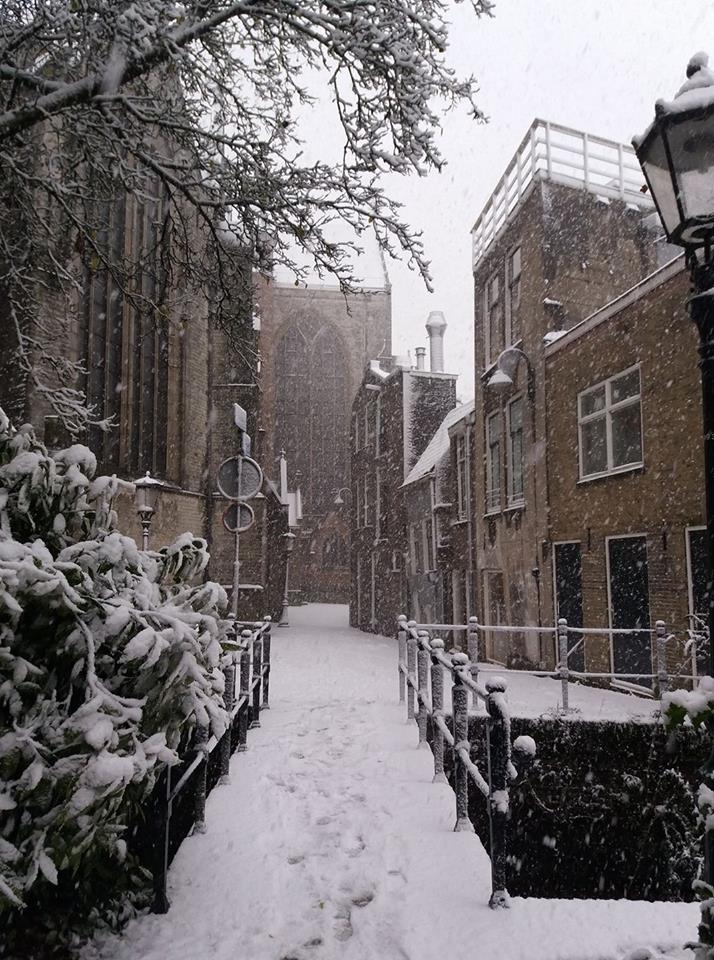
She finds herself walking along the path behind the Sint-Jan. Snow is falling. Everything is white. Near the stonemason’s workshop, piles of stones lie buried under snow. The railings of the bridge toward the Catharina Gasthuis wear thick white caps, and drifts hug the walls of the church.
One of the snowdrifts shifts.
Liza approaches cautiously and brushes some snow aside. Suddenly, she sees part of a face, blue from the cold. A small orange rim of a Santa hat peeks out as well. She plunges her hand into the snow, grabs an arm, and shakes it.
“You have to get up—you’ll freeze to death!”
The face tries to smile, but the cold makes it impossible. Slowly, the head shakes back and forth. Liza pulls again, but the body won’t budge.
Then, she feels a grip from behind. Her father’s voice cuts through sharply:
“Leave it. What do you think you can do about it?”
He drags her back toward the house. In the doorway, Pierre is doubled over with laughter, pointing at her.
“Don’t kid yourself that you can mean anything to him,” he mocks.
Dad pulls her inside, and Pierre slams the door behind them.
Liza jolts upright in bed, gasping for air. She clearly heard the front door slam. From the hallway come raised voices. She catches Pierre saying,
“I’ll decide for myself who I spend time with.”
Then the voices fade behind a living room door.
Liza sinks back into her pillow, her heart hammering. What did Pierre mean? Who was he talking about—his new girlfriend?
Her thoughts drift back to her dream, circling once again around Antonio. Is he really in the shelter tonight? What if there wasn’t enough space? What if someone else had pushed ahead? What if he arrived too late and his spot was given away? Then he would be out there now, lying in the snow.
She sees the bluish-white face from her dream again.
As soon as possible, she resolves, she’ll go to the church’s drop-in centre and ask what she can do to help him.
Slowly, she drifts into a light sleep.
 Nettie Leeflang